Archive 01
ClubHombre.com:
-Men's Health-:
-Safe Sex:
Test Kits For Safer Sex:
Archive 01
| By Sabio on Wednesday, February 26, 2003 - 12:43 am: Edit |
I would like to compare the safety (as far as HIV and herpes-2 are concerned) of covered sex without testing versus uncovered sex with testing, in view of the newly available test kits for HIV-1/2 and herpes-2. OraQuick test kit for HIV takes 20 minutes, and POCKit for Herpes takes 10 minutes. Both are FDA-approved, both easy to use, and both require only finger prick. Neither kit is over the counter in the US, but OraQuick is legally available over the counter in other countries for about $20, and I suspect that POCKit is, too.
Here are the two scenarios that I am comparing. You take a girl to your place, then
1. have covered sex with her, without testing.
OR
2. test her first (as you had told her you would), then have uncovered sex with her if the test is negative, otherwise send her on her way (as you had told her you would).
First, let's consider the accuracy of the tests. Both test kits are based on antibodies, not viruses. Therefore, they will be useless during the initial incubation period (typically less than 3 months for HIV). Other than that, OraQuick will return a negative when she is infected only once in 250 times, while POCKit will return a negative when she is infected only once in 25 times.
If you feel that this is not good enough to give scenario 2 an edge over scenario 1, please take into consideration the following factors:
1. Self selection: A girl who knows or suspects she has an STD is unlikely to go with you in the first place knowing that you will test her for that STD.
2. Side benefits: If you say you will test for "HIV and other STDs" when you negotiate with the girl, you may get the benefit of self selection with regard to other STDs that the girl knows or suspects she has.
3. Other protections: A lot of people who have protected sex still do DFK, BBBJ, and/or DATY. Under scenario 2, these activities would be somewhat safer than under scenario 1.
4. Correlation: Having one of the two viruses increases the likelihood of having the other, so the chances that an infected girl will fail at least one of the two tests are better than what the above numbers may suggest.
A few miscellaneous points:
1. Other than the side benefits above, I am not addressing the bacterial infections, serious as they may be; nor HPV, which has a lot of unknowns; nor hepatitis A/B, for which there are vaccines; nor herpes-1, which is mostly the all-too-common oral version. The comparison that I am proposing relates to HIV-1/2 and herpes-2 only.
2. Although not relevant to safety, but important in practical, moral, and emotional terms, OraQuick will almost never return a positive for an uninfected person, while POCKit will return a positive for an uninfected person about once in 33 times.
3. I assume that you know that you are negative for both viruses, so whether you too get tested in front of her is a practical (and fairness) question, with a subtle angle of self selection. If you do a lot of different girls, you can end up with too many holes
in your finger tip by the end of your trip  .
.
4. Although not part of the FDA approval, OraQuick can be used with oral secretions instead of a blood drop. POCKit does not seem to have that option.
Any answers? comments? corrections? information? experiences?
| By Sabio on Sunday, March 30, 2003 - 04:57 pm: Edit |
And the winner is ......
I have been researching the subject of testing versus covering in order to quantify the risks involved and have a fair comparison between the two scenarios above, and it's time to post the results. I will start with the conclusions, and then give the details and references. Although the conclusions are similar for HIV and herpes, the reasons are quite different.
Bottom Line
1. As far as catching HIV is concerned, an uncovered vaginal encounter with a provider who tested negative for HIV using OraQuick or MedMira Reveal is about three times safer than a covered vaginal encounter with a provider who was not tested.
2. As far as catching herpes-2 is concerned, an uncovered vaginal encounter with a provider who tested negative for herpes-2 using POCKit is about three times safer than a covered vaginal encounter with a provider who was not tested.
Main Components
The components of the calculation are:
1. The probability that an infected provider tests negative. These are one in 250 for OraQuick and one in 25 for POCKit.
2. The relative risk of uncovered versus covered vaginal encounter, which is a factor of seven for HIV transmission.
3. The "seronegative window" risk, that is the initial period after infection when a person can infect others with the virus, but still tests negative for antibodies (see thebody web site). The risk is affected by the length of the window, and the infectiousness during it.
It is component 3 that took most of the research. The details follow for herpes-2 (straightforward) and HIV (quite involved).
Herpes
Most of the risk in the testing scenario comes from the one in 25 sensitivity of POCKit. The seronegative window for herpes-2 is 13 days (median) which is very short compared to the professional lifetime of a provider, not to mention that it is the period of the first (and worst) outbreak that should be quite notable hence avoidable. Therefore, the added risk of the seronegative window is very small, and the "three times" estimate comes from comparing 7 for condoms to 25 for POCKit, rounding in favor of condoms.
HIV
This is where it gets a bit complicated. The one in 250 sensitivity of OraQuick is so large that the risk mostly comes from the seronegative window. First, I thought the only factor of that risk was the length of the seronegative window compared to the professional lifetime of an HIV+ provider (since this would give us an estimate of the percentage of HIV+ providers in their seronegative window). That would have made test kits MUCH safer than condoms.
Then came bad news for test kits: Providers are more infectious during the seronegative window because of the high viral load. The viral load measures how much HIV there is in the blood stream. The higher the viral load, the more infectious the person is, which makes sense since there are more viruses to go around. It also makes sense that the viral load gets high during the seronegative window since the antibodies that fight the virus have not formed yet, hence the virus is having a field day multiplying.
Then came some good news for test kits. The profile of the viral load is high only for a short period, and the resulting infectiousness increases slowly with the viral load. By calculating the average infectiousness from the profile, we get that the seronegative window is equivalent to 80 days of post-window infectiousness. If the professional lifetime of an HIV+ provider is about 5 years, we arrive at the "three times" estimate, again rounding in favor of condoms. If it is more than 5 years, the edge of the test kits will be higher.
Like the herpes initial outbreak (but definitely less dramatic), there are symptoms for the seronegative window in the case of HIV. This is something that I did not know before as I assumed HIV to be totally asymptomatic until full blown AIDS develops. The most common symptoms are fever and rash which should be somewhat notable. Although this factor magnifies the edge of test kits, it was not considered in the "three times" estimate as it is a bit subjective.
One more factor that favors test kits but was not considered in the calculation is that higher viral loads seem to trigger antibody formation, hence shortening the dangerous "blind" period for the test kits.
Final Word
I tried my best to seek out credible references, and to make an unbiased calculation. I would welcome any remarks that criticize or support my references or reasoning, any relevant information that can be verified, or any questions about any aspect of this post. If I made an error, please tell me.
| By Laguy on Sunday, March 30, 2003 - 06:18 pm: Edit |
Sabio: I'm rather skeptical of the report you cited suggesting that wearing a condom lowers HIV transmission by only 85 percent among those who are consistent condom users. I would think that condom usage probably has a greater effect than lowering the probability of HIV transmission by 85 percent. There are a few reasons for my skepticism. First, I assume the study was based on self-reports of condom usage, and there often is some degree of lying when it comes to self reports about sexual behavior, lying that may be skewed towards reporting condom usage when none occurs. Second, the report talks about "consistent" condom users, which might (its actually unclear) include people who use condoms less than 100 percent of the time. Also, meta-analysis (reaching statistical conclusions from a number of disparate studies, without consistency in the methods used in the various studies) in this venue is fraught with all sorts of possible problems, including the one's I have already identified. I haven't looked at the studies that were fed into the metaanalysis, nor have I spent more than about two minutes reading the cited article (time permitting, I may look at the study itself sometime in the future). However, I would urge caution before concluding that condoms may only be "sort of" effective in stopping HIV transmission.
| By Jdx911 on Sunday, March 30, 2003 - 07:42 pm: Edit |
Speaking of OraQuick, where is this product being sold? Or is it only being shipped to health care providers and the military? I heard that OraQuick would be able to be bought over the counter.
Any information on this rapid HIV-1 test would be very helpful.
Thanks,
JDX
| By Sabio on Sunday, March 30, 2003 - 11:52 pm: Edit |
laguy
I think you will enjoy reading the full NIH report, whose URL is included in the State Department web page summary above. It really is done by professionals, and with the credibility of the NIH behind it, I tend to buy it even if it surprised me. Consistent is defined in the report to be 100%.
It makes it a bit easier to swallow when we consider that condoms are only ten to twenty times effective in preventing pregnancy (when used correctly), and a sperm is bigger than a virus .
Definitely caution is called for, and I would like my post to be taken as a statement for test kits rather than a statement against condoms.
| By Sabio on Sunday, March 30, 2003 - 11:58 pm: Edit |
jdx911
Officially, in the US, OraQuick can be only shipped to a medical entity per FDA regulations (see OraSure's web site), but I heard reports of its availability over the counter overseas. MedMira Reveal (the 3-minute HIV kit) will target the general public as their distributor says in their web page.
| By Sabio on Tuesday, April 08, 2003 - 05:20 pm: Edit |
A picture is worth a 1000 words. Here is the OraQuick 20-minute test kit:
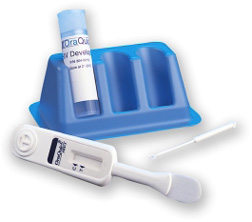
Some love it , some hate it  !
!
(Message edited by sabio on April 08, 2003)
(Message edited by sabio on April 08, 2003)
| By Sabio on Tuesday, April 15, 2003 - 05:51 pm: Edit |
Posted by Canonperdido in another section:
If you ask the provider to take a test, she is going to make you take one on the spot. Whatever mood there is will be lost.
True that it is not practical if you are making the termas rounds and doing different girls for 40 minutes each, but say you picked up someone and hit it off the first night (covered) and want to keep her for 2-3 days. I think testing plus bareback would be a good option there. Even if it is the first time with a girl, remember that testing, like money negotiation, is done before the action starts and can be business-like without necessarily interfering with the mood of the session once it is behind you.
| By Sabio on Thursday, April 17, 2003 - 11:38 pm: Edit |
Dogster wrote (in another section):
One issue I wonder about is test bias (as opposed to test sensitivity). To what extent is the test conservative (i.e., biased toward detecting any and all cases of HIV, but with the consequence that there are some false positives) or liberal (i.e., biased toward detecting only cases that are clearly HIV, with the consequence that there are some false negatives). My guess is that it is a fairly conservative test, which means that there'll be a fair number of false positives. If you are told you have HIV when you don't, that has some pretty huge disasterous consequences. Alternatively, if you are told you don't have HIV when you do, that has some pretty huge disasterous consequences, too. This is a long way of saying that I wonder about the "signal detection characteristics" of those quick tests. There's no signal-detecting test on the planet is perfect, so what kinds of errors does this particular test make?
You raise excellent points. Let me start by giving the numbers, then discuss the issues you raised. The rate of false negatives (an infected person testing negative) for OraQuick HIV test kit is one in 250 (formally, the sensitivity of the test is 99.6%). The rate of false positives (an uninfected person testing positive) is practically zero as no cases of false positive were encountered in the tests (formally, the specificity of the test is almost 100%). For POCKit (the genital herpes test), the rate of false negatives is only one in 25, while the rate of false positives is one in 33.
As you point out, neither a false positive nor a false negative is to be taken lightly. From strictly a safety point of view, false negatives are the issue. But false positives have moral, psychological, and practical implications to be reckoned with. For HIV, given the above numbers, false positives do not seem to be an issue, but for herpes it is an issue (albeit less traumatic).
Another issue I wonder about has to do with possible paradoxical effects of the tests. Remember a few years ago when people discussed the risks of using sunscreens? Users of sunscreens were actually spending more time in the sun, thereby increasing some risks despite the presence of a screen. It could be similar with these tests. If you and your partner test negative, you might go bareback more often (i.e. more exposure), which increases risk.
This is an angle I did not think about. It brings up the general concern that test kits are uncharted waters, and some factors may come into play like this paradoxical effect that tilt the safety balance in favor of the tried and proven status quo. However, I think the factor of 3 in favor of test kits that was calculated in the above post (March 30) provides a comfortable margin of safety for the kits.
Additionally, going bareback based on a negative result from one of those tests will increase the risks of any and all other STDs, including some that are incurable (HPV, herpes).
HPV is a problem, but my research so far has led to more questions than answers (including whether condoms are at all effective in preventing HPV transmission). Genital herpes (type 2) has its own test kit (POCKit). It seems that, other than HIV and genital herpes, STDs do not seem to be a sufficient deterrent for condom users who nonetheless practice DFK, BBBJ, DATY, etc, on a regular basis.
Good, good, good. I'm glad you are posting here. You've obviously thought a lot about these issues.
HPV remains a huge question mark, as far as I can tell.. And even MD's who should know better have been spreading misinformation about it. An MD who posts here frequently was providing misinformation about HPV and its treatment until he finally looked at the facts, and he's fairly typical. (see men's health section).
You are of course correct that we don't know if condoms are effective at presenting HPV transmission. And some types of HPV (incurable) are carcinogenic, among other things.
Anyway, I'm trying to picture myself actually using those test kits. I'm working on it...
I had the experience of using one of these Oraquick tests today when I visited a local Planned Parenthood for my quarterly test. Quick and easy. Does anyone have any info on a non-medical professional obtaining these kits. Canadian pharmacies...that sort of thing. Any help would be much appreciated. I agree that these things might come in handy for the more sustained encounters or those occasions when one encounters a girl who is latex allergic (believe it or not, this has happened to me twice this year).
| By Sabio on Saturday, April 19, 2003 - 09:47 pm: Edit |
Artist: Only one poster said that he managed to buy OraQuick in Thailand. He spelled it OraKwik, which I hope was just a misspelling not an imitation brand . I checked several pharmacies in Bangkok myself, and none of them had it. The owner of one of the pharmacies who was familiar with both OraQuick and POCKit told me that the Thai government now allows only private hospitals to sell the test kits.
Internet vendors seem more promising, and I am looking into that now. One small distributor of POCKit said in his e-mail:
you will have to name a physician, medical professional, medical institution, clinic, or anywhere with similar for which to address the shipment to
which sounds somewhat flexible. I found some Internet distributors of medical supplies who regularly ship similar stuff to any address without a problem, but I could not find one who lists OraQuick yet.
Anyone who can post related information will be appreciated.
| By Sabio on Tuesday, May 27, 2003 - 11:25 pm: Edit |
FDA approves the 3-minute HIV test kit MedMira Reveal:
The Canadian company MedMira completed shipping 500,000 Reveal HIV test kits to the US distributor Cardinal Health, less than one month after receiving the FDA approval. The FDA web page states that MedMira rapid HIV test was approved on April 16, 2003 for detection of HIV-1 and HIV-2 antibodies.
The Reveal kit gives results within 3 minutes, compared to OraQuick that gives results within 20 minutes. The manufacturer's web page talks only about HIV-1 (by far the more common strain in North America). They report an independent clinical study that verifies the accuracy of the test.
Like OraQuick and POCKit, Reveal was approved for point-of-care diagnostic purposes, and is not available yet over the counter in the US.
Hey Sabio,
Didn't you just get barred from WSG for this same shilling of kits? Why don't you come clean and tell everyone your commercial affiliations.
| By Sabio on Monday, June 09, 2003 - 10:44 am: Edit |
Dashing Don:
My membership in the other web site is still active. I chose to stop posting there since the moderator had reservations about the subject.
I have no commercial affiliations related to test kits. I am just convinced that the kits have a role to play in the hobby. Not for everyone, though.
Have a nice day.
Again Sabio, I ask you to come clean. When you say that your "membership in the other web site is still active" you neglect to mention that you were relegated from Senior Member to Regular Member. And the reason was that the moderator had reservations about YOU, not about the subject.
| By Sabio on Monday, June 09, 2003 - 08:45 pm: Edit |
Dashing Don:
Thank you for the information.
| By Sabio on Saturday, June 21, 2003 - 10:58 am: Edit |
A guy in the Cambodia section of another board posted last week that he could buy OraQuick for $25 from "many pharmacies" on Sukhumvit road in Bangkok. When I was in LOS in March, I checked a number of pharmacies with no luck, but they were not in the Sukhumvit area. Anybody currently in LOS care to check this out (in a break between sessions ). There are a couple of major pharmacies close to skytrain stations.
BTW, the same guy posted in the Rio section of that board that he tested one of the garotas then went bareback with her. If true, this would be the first field test by a hobbyist that I know of.
| By Sabio on Sunday, June 22, 2003 - 11:48 am: Edit |
Another poster from yet another board (vipadulttravel.com) managed to buy OraQuick in LOS from Surawong Medical Center near Patpong. The availability there was confirmed by someone else from nanaplaza.com, so any hombres interested in buying the kits can just take a 2-minute walk from Patpong and get them (if anybody goes to the Pong nowadays ). The price is 500 Baht per kit, or 2000 Baht per 5 kits.
The poster used the kits in the "field" and provided a detailed TR about the experience. I am trying to get him to post his experience here at CH. If not, I'll summarize what he wrote and post it.
I am finding more posts on different boards about the actual use of the kits in the hobby. All of them have used the oral feature of OraQuick, not the finger stick (they just pass a Q-tip type of device in the girls mouth, and put it in the kit's solution). One guy took the kits to Cambodia and used them with a number of girls from a local brothel. Two other guys used them in LOS, one with no problem and the other had one girl accept the test and another refuse it. None reported any tests failing or returning positive.
| By Sabio on Wednesday, July 16, 2003 - 12:28 am: Edit |
HIV positive report from a poster on another board (3 days ago, abridged):
The advice of always using a condom is very good advice. I for one do not like to use condoms as well. If the only STD you are worried about is HIV one way around it is using a test kit from OraQuick. HIV test. It is kind of expensive 500 Thai baht per test or 5 for 2000 Baht. I first heard of this test kit on the old Penhball site. It may be expensive but how much is your life worth?
Last night I took a girl from Martini's and tested her before any action took place. She came up POSITIVE for the Anti HIV antibodies! Decided it was not in my best interest to have sex with her. Gave her some money and asked her to leave. I was nice about it but as I see it I have to look out for number one.(Me)
I bought the kit at a clinic near Patpong on Suriwong Road. As mentioned a couple years back on Penhball. Coming out from Patpong 2 and Suriwong turn right and walk to the next soi turn right into the soi and about 20 feet into the soi is a clinic called Suriwong Clinic ask the ladies at the counter as you enter for the OraQuick HIV test kit and they will know what you are talking about.
As I see it I'm better off safe than dead!
| By Sabio on Friday, August 01, 2003 - 08:13 pm: Edit |
Same efficay for saliva or blood, according to a poster on another board. Originally posted yetserday (abridged):
Guy, a few clarifications:
Oraquik does use blood or saliva. It's no trick found in Mexico. It's right in their company (printed) literature. I know their website says blood, and the FDA has approved it as such but the instructions and insert say both have equal efficacy. I know because I still have two test kits. You can buy them legally overseas. It is no 'black market' thing, but because of them not being approved for release to the general public in the USA. In fact, on the packaging it says "Not for Sale Outside Thailand".
BTW, Oraquik has been ClIA waived, but last I heard they are still not going to release it to the general public. Totally stupid IMHO as it's as easy to use as a pregnancy test.
| By Sabio on Tuesday, September 02, 2003 - 10:28 am: Edit |
A number of good points from a poster on another board yesterday (abridged) in response to another poster's concerns about the practicalities of using the kits.
I would like to relate to you my actual experiences with these tests here, including a girl who tested positive late one night.
First let me say that when the tests are finally made available to the public, over the counter, at every pharmacy, they will then contain items similar to these which I hope would allay most of your fears:
-Instructions in Thai, English, German, French, Italian, Spanish, etc., as well as pictorial instructions.
-Information that NO HIV test is 100 percent accurate.
-Negative results in the literature would be stated as "Likely Negative"" and Positive results as "Re-test" , with instructions to call for counseling and be re-tested if the result is "Re-test".
-Phone numbers to a 24 hour hotline available for Thai speaking persons so they could be counseled in the event that the tests results were questionable. I know Thai Doctors and Nurses who would and have volunteered for this duty.
-Every test would contain a condom, and advice to use it, as well as other useful information about STD's, and counseling services.
Let me also say that the proper place and time to have an HIV test is in the privacy of your home, before you have sex with a new partner. NOT AFTER you have been infected by, or infected, them;
Just as the proper place to to have a glucose test is in the privacy of your home, before you inject yourself with insulin. It is also accepted that this is the proper place for pregnancy tests, ovulation tests, cholesterol tests, colorectal cancer tests, and others.
The US FDA believes that it is acceptable for people to receive the information that they have HIV without a doctor or counselor present, in the privacy of their home. They do not believe people will go suicidal and kill themselves.
The US FDA has approved home test kits for HIV; although these require a three day wait for the lab to process, after which you call in with a unique PIN number and the tests results are given to you by an answering machine. Privately. WITH NO COUNSELOR PRESENT! There is little difference between this test and the rapid test except the factor of time, which is critical if one is hoping to stop the risk of infection.
NOW BACK TO MY STORIES - when testing the viability of providing access to these tests, we would have entire bars filled with girls sticking their fingers out at us asking us to test them. We tested entire bars. They would generally giggle and laugh alot, then run and hide in the bathroom while their tests developed. Oddly enough, none of the girls we tested in this manner were positive (we were not in Bangkok or Pattaya).
The bar girls were the most eager to be tested by us. Why? THEY DID NOT WANT A THAI DOCTOR OR MEDICAL AUTHORITY TO TEST THEM!!! If they were positive, they did not want anyone else to know, especially the Thai medical community! They would avoid testing for this reason. They believed they would suffer some type of repercussion if this were on their medical history.
THE POSITIVE GIRL - Ja - One night, on Songkran, I met the girl of my dreams at a disco, she was 19, and a picture of health. She charmed me, I was hooked, I really liked her. When we arrived at my house she cleaned the whole place, washed the dishes, cooked a meal, took a shower and came bouncing out in her tiny towel. I prayed to God that everyone was wrong and it could work out between a Thai and a falang. I asked her if she would test and she cheerily agreed.
She was positive. We tested her again. She was positive. I told her that she needed to be retested at a hospital and I put her on the phone with my partner who is a Thai MD. They spoke for about 10 minutes. I was completely distraught. This angel of a girl - 19 - had HIV. She smiled and calmed me down and comforted me all night. The next day we took her to the local clinic and she tested positive again. She told me not to cry. She left that day to go home without saying a word.
She got in touch with a friend of mine who sent me her photo and cell number after I returned to America. As of two years ago she was working, but now her cell phone number is not. Should I have stayed with her anyway? I don't know.
But, if I had not found out this information on that night, I could easily have stayed with her long enough to have have had an accident while in using a condom. Also, after we parted, she could have wound up unknowingly infecting many others (she said she always insisted on a condom after she found out she was HIV+).
Yes, it was a difficult experience, but I am HIV negative....
Now another case. A friend of mine is a male nurse in Miami. He took a girl home on Pattaya and while they were having sex, the condom broke, and he finished anyway. When he turned on the lights there was alot of blood. She was on her period and informed him that she was HIV+. He wished he had brought tests with him on that trip and used them. He is still HIV- today.
Those are some of my experiences. I hope the general public starts using these tests regularly soon.
Allowing the general population access to these tests WILL help stop the spread of HIV.
If someone you know tests positive please provide them with the following phone#'s -
The following organizations claim counseling support for Thai people:
#1) Wednesday Friends Club
Hotlines 02-255-7893, 02-255-7894.
ALSO:
Counseling Centre & HIV/AIDS Clinic Hotline
Tel. 02-276-2950, 277-7699. Fax 02-691-4057.
Bodang Drop-in Center
830 Galaxy Lane, Thanon Rama IV, Bangrak, Bangkok.
Tel. 02-255-7893, 02-255-7894.
Hours: Mon.-Fri. 12.00 to 17.00; Sat. 09.00-12.00
Anonymous Clinic – Thai Red Cross
1871 Thanon Rama IV, Bangrak, Bangkok.
Tel. 02-256-0410
| By Sabio on Saturday, September 06, 2003 - 12:52 pm: Edit |
Popular Science Magazine article about OraQuick just came out. Only the FDA-approved use (finger stick) is covered, but the article refers to the oral version at the end.
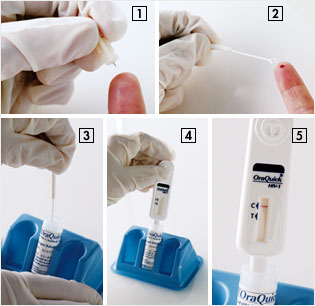
A lancet draws a blood droplet (1), which is scooped up by a plastic specimen loop (2). the sample is mixed with a developing solution (3). A test-reading device is dipped into the viAL and sits for 20 minutes (4). a single pink line at the control area (c) means the test is negative (5).
Finally, a simple, fast test for HIV.
by Abby Christopher
An estimated 200,000 Americans don't know they are infected with the human immunodeficiency virus, or HIV. Now the government is banking on the vast distribution of an on-the-spot HIV test, called OraQuick, to make those unaware of their condition aware. And fast.
Testing, of course, has long been a critical piece of HIV prevention campaigns-those who learn they have the virus are far less likely to pass it on to others. But a traditional lab-based test requires a large blood sample, which must be drawn by a medical professional, and necessitates a two-week wait for results. Each year, an estimated one-third of those who test positive never return to check their status, says Dr. Bernard Branson of the Centers for Disease Control and Prevention.
With OraQuick, there's little time for second thoughts. Anyone with simple training can administer the test, which is as easy as pricking a finger, and the results appear in less than 20 minutes. The test has an accuracy rate of 99.6 percent, on par with conventional tests. Since the FDA approved its use in hospitals and clinics last November, the rapid test has received uncharacteristic praise from public health officials. The CDC, for instance, has made OraQuick the centerpiece of a $35 million push to revamp federal prevention efforts. The agency recently purchased 250,000 kits from manufacturer OraSure Technologies for nationwide pilot testing.
At the heart of the test: a strip of noninfectious synthetic proteins built to mimic structures found inside and outside the HIV virus. If HIV antibodies are present in the blood sample, they attack and bind to the proteins, triggering two pink lines to appear on the testing device. The basic science needed to invent the test, says OraSure chief science officer Sam Niedbala, took nearly 20 years of collaborative work by worldwide research teams. There were also social hurdles to clear, mainly the possible dire consequences of a positive reading with no counselor on hand. (For that reason, you won't find OraQuick at your local drugstore.) Next, the company hopes to make testing even easier by replacing OraQuick's lancet with a cheek-swabbing device that is currently in clinical trials around the country.
| By Jurgen on Saturday, September 06, 2003 - 07:02 pm: Edit |
If your in the states, I have used this company for HIV testing. You basically pay them $35 for testing at your local labs. You then call their main office about 10 days later for the result
http://www.ehivtest.com/59-dollar-test.asp
| By Shy_guy on Monday, September 08, 2003 - 11:01 am: Edit |
Haven't seen this posted yet, so I'll offer that the HSV-2 POCkit test is no longer available secondary to I believe financial problems with the manufacturer. There is still a highly accurate screening test for antibodies to herpes simplex virus (which can identify both and correctly differentiate between type 1 and type 2) available in the US called Herpeselect from Focus Technologies, but this does require sending a blood sample to a clinical laboratory for testing, thus it doesn't fit into the scheme of quick home-based screening.
| By Sabio on Tuesday, September 09, 2003 - 11:05 am: Edit |
Shy_guy
You are right. Diagonology has gone out of business. Thank you for updating us.
Not clear yet if another company will take over the POCKit technology, or it is gone for good. Too bad really, as this was the only FDA-approved fast HSV-2 test, and genital herpes is of course far more prevalent than HIV and much easier to catch (can happen even without an outbreak).
I looked into HerpeSelect. As you indicate, it is not a fast test kit in the sense of this thread. It seems unlikely that it can be modified into one as it cannot be stored at room temperature, among other things.
Jurgen:
Thank you for the link. If the circumstances allow it (time frame mostly), it is indeed best to do the testing at a professional lab. In this case, I would opt for the PCR test (DNA based) since it can detect the virus as soon as 10 to 20 days after exposure. It is also a very sensitive test, so a negative result would be extremely reliable. The catch is that it is more expensive than antibody tests.
| By Bomboa on Saturday, September 13, 2003 - 07:07 pm: Edit |
Sabio,
How much is the PCR test typically? The biggest problem I see is figuring out - on the spot - whether the garota you're with might be a carrier. Condoms can stop AIDS, but nothing will stop herpes and genital warts. I've seen enough suspicious looking marks on even the most upper class of hookers in Brazil to take this lightly, and appreciate your informed research on this topic.
When you get to the terma and Help girls, I think the risk goes up exponentially given the number of guys they sleep with. And it goes without saying that a certain % of guys who roll through Brazil - particularly the termas and Help in Rio - are carrying STDs either knowingly or unknowingly.
Have you heard of any preventative methods for herpes and genital warts? I read an article a long time ago which said that a common ingredient in toothpaste and shampoo kills these viruses on contact. So I always wash before and after with a heavy dose of soap and shampoo. Not sure if it does anything, but I figure it can't hurt.
| By Sabio on Sunday, September 14, 2003 - 11:00 am: Edit |
Bomboa:
I do the HIV test only in clinics that allow anonymous (not just "confidential") testing, and I think they are more expensive than other clinics. Last time I did the DNA PCR test it was around $200.
Your point is well taken about the high-volume venues like termas. Other things being equal, a girl who does 5 guys a day is a bigger risk than a girl who does one guy.
With the demise of the POCKit manufacturer, I currently don't know of any on-the-spot way to prescreen the girls for herpes. The problem is that herpes can be transmitted without an outbreak, and the test kit had the distinct advantage of working in the absence of an outbreak.
As for genital warts, it's troublesome territory. Precious little is known about prevention, and condoms don't seem to do the trick in this case. I don't know about chemical-based preventive methods.
I believe HIV is still the major risk. Although the probability of transmission per act is small (ballpark one in a thousand), and although condoms further reduce that risk (seven times per NIH), the stakes are so decidedly high.
| By Bomboa on Sunday, September 14, 2003 - 12:56 pm: Edit |
I always thought this was a great, no non-sense article about STDs:
STD Blues: A Self-Defense Guide
http://www.doitnow.org/pages/h103.html
What it boils down to is this:
1)If you see blisters, growths, or sores near the genital organs or mouth, you better put your pants back on and walk away [as Sabio mentioned though, you can get Herpes when it's not visible on the girl]
2)If you see a discharge or drip from the genital area, then definitely walk away.
3)Always take a leak after sex and always use good soap to completely wash every inch of your body, before and after the act; might even be worth brushing your teeth too.
I'm glad Sabio has been continuing to post on this thread, because this is serious stuff. I can't tell you how nerve-wracking it's been, sitting at a clinic and waiting for my results to come back.
Thankfully, they were negative but I sympathize with those (many of whom are probably on this board) who did pick something up. It was a crushing blow for my friend who was diagnosed with herpes, and it destroyed his relationship with his long-time girlfriend in the States.
| By Bomboa on Sunday, September 14, 2003 - 01:18 pm: Edit |
Not sure what the latest is on this, but there appears to be some credibility to the tooth paste / common shampoo rumors...
http://archive.salon.com/sex/world/2000/09/27/microbicide/
| By Sabio on Sunday, September 14, 2003 - 08:18 pm: Edit |
Thank you for the excellent reference, Bomboa.
An informed discussion of STDs is vital. People may tend to avoid the subject altogether because it is depressing. However, if someone catches a bad STD that was readily avoidable, that is depressing.
One can do all the serious research ahead of time and decide on safety measures to go by and stick to them without further ado. This way, the fun during the real thing is not diminished by unconstructive worries.
Of course luck plays a role in it, like in many things in life. Whether someone will be lucky or unlucky is not under their control. What is under their control is to choose a method that has better odds.
(Message edited by sabio on September 14, 2003)
You guys are dreaming if you think that you are going to find and on-the-spot herpes, or genital warts test.
Dream on.
OH
| By Sabio on Sunday, September 14, 2003 - 10:43 pm: Edit |
Otrohombre:
Sorry? POCKit is such a test.
| By Bomboa on Monday, September 15, 2003 - 03:42 pm: Edit |
Lacking such a test, just look carefully, wash thoroughly, and pray often.
Oh, and avoid high-mileage hookers whenever possible. I think 40% of hookers from Santos were HIV+.
| By Sabio on Tuesday, September 23, 2003 - 10:29 am: Edit |
A study in the 2002 International AIDS conference addressed the ability of non-professionals to administer on-the-spot HIV tests using finger-stick fast kits such as Determine. The context was obviously not that of a hobbyist testing a provider , but to the extent that conclusions can be drawn about the ease of using the kits and the accuracy of the results obtained when non-professionals administer the test, the study shows very promising statistics.
Title of the study:
Evaluation of the performance of non-laboratory staff in the use of simple rapid HIV antibody assays at New Start voluntary counseling and testing (VCT) centers
| By Sabio on Monday, October 06, 2003 - 10:58 pm: Edit |
4 snips about OraQuick from the periodic HIV Prevention News Updates of the US Centers for Disease Control over the past month.
Friday, September 12, 2003:
A total of 225 women were tested using point-of-care HIV testing, and 155 were tested relying on the laboratory. The average turnaround time for getting the results was 45 minutes for the three hospitals using point-of-care testing. This was four times shorter than the 3.5-hour turnaround time at the hospital using laboratory testing. The OraQuick test itself takes just 20-30 minutes to run. At each hospital, OraQuick rapid test results were confirmed to be 100 percent accurate using standard lab tests, when needed.
Monday, September 29, 2003:
"Prevention Effort on HIV Transfers Focus to Carriers" - Los Angeles Times (09.29.03)::Daniel Costello - For two decades, health officials focused most HIV prevention efforts on keeping high-risk groups from being infected. However, in a strategic shift last year, California's Office of AIDS redirected up to 25 percent of the state's annual prevention budget to "prevention for positives" programs. In April, CDC announced it would begin heavily favoring programs aimed at preventing HIV-positive people from spreading the virus. Programs expected to benefit under the state and federal mandates include: individual counseling with HIV-positive patients and their partners; routine HIV testing both inside and outside medical settings (aided by the rapid OraQuick test)
Tuesday, September 30, 2003:
Associated Press (09.29.03) - Bethlehem, Pa.-based OraSure Technologies Inc. said it was applying Monday to the US Food and Drug Administration for pre-market approval of its OraQuick rapid test for use in detecting HIV antibodies in saliva or plasma samples. "This filing is the next major step in our efforts to expand the versatility of the OraQuick test," said OraSure CEO Mike Gausling. The OraQuick test was the first rapid, point-of-care test approved by the FDA to detect HIV antibodies in blood specimens - giving results in about 20 minutes. FDA approval for testing saliva or plasma would broaden the appeal of the test by providing advantages over competing blood or urine HIV tests, said Gausling.
Wednesday, October 01, 2003:
Other research presented at the conference demonstrated the value of the OraQuick Rapid HIV-1 Antibody Test in reaching high-risk individuals outside medical settings, and also showed that health care workers do not need extensive training to perform the test correctly.
(Message edited by sabio on October 06, 2003)
If any of you guys gets a hand on OraQuick and goes to Brazil, bring me a few packs. I will pay, of course
1234567 at innocent.com
I found tests that also test for hepatitis C. Of course I assume you are vaccinated for hep B
| By Sabio on Tuesday, October 07, 2003 - 11:11 am: Edit |
Yes, I am vaccinated for Hep A and B. IMHO, every hobbyist should be.
| By Bomboa on Sunday, October 12, 2003 - 07:57 am: Edit |
Same here. By the way, I recently bought some Sodium Lauryl Sulfate gel-based soap and plan to use it generously before the act and after-wards, without exception.
Interesting discussion I read on WSG was from a provider in the business who had worked for 10+ years without getting one STD.
She followed the steps outlined above (examination, condom, soap before and after). She admits to kicking out a lot of johns after she found them with warts, herpes, etc. But the soap before and after I think may have unwittingly been what kept her safe.
Where might San Diego-based hobbyists get the test for Hep. C, and the Sodium soap?
What about the possibility of catching some other nasty STD's, such as syphilis, when not using a condom? That is, it seems we may still need a thorough doctor's exam, before not using a condom.
Thanks,
avisar2004@yahoo.com
| By Sabio on Sunday, October 12, 2003 - 11:00 pm: Edit |
Robert Johnson:
Any clinic that offers Hep A&B immunizations will also have the various Hep tests available. I am afraid I am not familiar with specific clinics in San Diego.
Bomboa may be able to help with where to get the sodium soap.
About condoms, they definitely provide some level of protection against most STDs. This thread is not meant to tell people not to use condoms. It does give people who don't use condoms an alternative protection method. The situation is similar to distributing condoms to teenagers. Some feel that this puts teenagers at risk since it may encourage them to have sex, while abstinence is definitely safer. Some feel that teenagers will have sex anyway, and, given that they will, distributing condoms gives them at least some protection.
Although seldom admitted in posts, not all hobbyists use condoms with providers as this recent poll indicates.
Where does one buy this soap? [Sodium Lauryl Sulfate]
Sbronx77.. Read the ingredients of you bottle of shampoo.
Also here is a very interesting article regarding safe sex practices. http://www.utmb.edu/newsroom/01pr_archive/jul_2001/lubricant.htm Theoretically you are much adding some good ol' Astroglide. Probably a bunch of crap, but it is a semi reliable source and there is certainly nothing wrong with a good glop of Astroglide anyway so what the heck. I'll implement that practice.
(Message edited by I_am_Sancho on October 20, 2003)
| By Sabio on Wednesday, December 31, 2003 - 02:06 pm: Edit |
I don't know about the legality of testing the blood of a patient without his/her consent under these circumstances (they can't possibly mean testing the exposed health worker since such tests are useless immediately after exposure). Anyway, here it goes.
FDA Approves Rapid HIV Test
Wall Street Journal (12.30.03). Dublin-based Trinity Biotech PLC announced that the US Food and Drug Administration has approved its 10-minute HIV test, the Uni-Gold Recombigen HIV Test. It is the first rapid-test product approved for testing blood serum, plasma and whole blood.
Company President Brendan Farrell said the test "is every bit as accurate as lab-based tests." The test requires one drop of whole blood, serum or plasma; in trials of 9,000 patients, Trinity's test detected 100 percent of HIV-positive specimens and was 99.7 percent accurate on negative samples.
Trinity plans to market the test to hospitals, physicians and government programs for quick testing of health workers who accidentally prick themselves with used needles. The firm expects to sell 400,000-500,000 tests in the United States in 2004. The tests cost $10 each. Uni-Gold is approved for use in the World Health Organization's HIV testing program in Africa, and is also sold in Asia.
Uni-Gold will compete directly with OraSure Technologies Inc.'s OraQuick Rapid HIV-1 test, approved in Nov. 2002. That test takes 20 minutes and only works on whole blood. Trinity plans to target the roughly 200,000 pregnant women considered at risk for mother-to-child transmission of HIV. It will also market to CDC's programs, which Farrell estimates to be a $30 million potential market.
HIV 1,2,0 Hepatitis B,C instant test, all in one, sold legally in Dutch pharmacies ....
I got a bunch of them here in Rio, if someone wants to try them.
they seem to be produced in Canada
http://www.mirates.com/
> > >
> > > MiraTes HIV test Euro 19.50 each
> > > MiraTes Hepatitis C test Euro 19.50 each
> > > MiraTes Combined HIV-Hepatitis C test Euro 22.50 each
> > > MiraTes Helicobacter pylori (stomach ulcer bacteria)test Euro 19.50
each
> > > MiraTes Prostate (PSA)test Euro 19.50 each
> > > MiraTes Cholesterol test Euro 19.50 each
> > > Mirates HBV / HIV / HCV Triple test Euro 19.50 each
| By Sabio on Saturday, March 27, 2004 - 12:12 am: Edit |
Proctor has just posted the following newsflash:
FDA Approves Rapid Saliva Test for AIDS Virus
By Lisa Richwine 3/26/2004
WASHINGTON (Reuters) - The United States approved the first rapid saliva test for the HIV virus (news - web sites) that causes AIDS (news - web sites), health officials said on Friday.
The test, made by OraSure Technologies Inc., provides results within 20 minutes with 99 percent accuracy. Other approved rapid HIV (news - web sites) tests require blood samples.
Shares of Bethlehem, Pennsylvania-based OraSure gained $1.55, or 19.02 percent, to close at $9.70 on Nasdaq.
"This oral test provides another important option for people who might be afraid of a blood test," Health and Human Services (news - web sites) Secretary Tommy Thompson said.
Officials also said the test, called the OraQuick Rapid HIV-1/2, could help on two fronts, encouraging more people to get tested as well as actually getting them the results.
One-fourth of the roughly 900,000 HIV-infected people in the United States are not aware they have the virus, according to estimates by the Centers for Disease Control and Prevention (news - web sites).
People given standard tests that take a week or two often do not return to get the results. With a rapid test, a patient can get an answer in just one clinic visit. Those who test positive can start treatment quickly and take steps to keep from spreading the virus.
The new saliva test also helps protect health-care workers from becoming infected with HIV because they do not have to handle blood, officials said.
The device could be a valuable tool in fighting the AIDS epidemic in Africa because it is so quick and accurate, Thompson said.
U.S. aid agencies at some point might buy the tests for distribution in Africa, but no plans are yet in place, Thompson said.
The OraSure saliva test is cleared for detecting antibodies to HIV-1, but not for HIV-2, the strain prevalent in parts of Africa. OraSure's 20-minute blood test for HIV is approved for both types.
Only a minority of African patients who test positive for HIV have access to medicines that can suppress the virus.
The Bush administration came under criticism this week from AIDS activists, who accused the government of pushing expensive, brand-name drugs in poor countries over cheaper generics. The administration has said it is concerned that the generics, which often mix several drugs in one pill, may not be safe or completely effective in the long term.
The new test involves wiping a swab along the gums and placing it into a liquid in the testing device. When antibodies to the HIV virus are detected, two reddish-purple lines appear on the device.
Results should be confirmed by a second, more specific test, the Food and Drug Administration (news - web sites) said.
At first, the new saliva test will be available only at hospitals and major clinics which are approved to use that type of test. OraSure could apply for a federal waiver to allow more widespread use at health-care facilities.
The saliva tests could eventually be sold without prescription in drug stores, as pregnancy tests are, Thompson said. The test would have to clear several regulatory hurdles first.
Officials would have to consider how patients might react to the results at home, without health-care workers on hand, said Jesse Goodman, director of the FDA's Center for Biologics Evaluation and Research. False positives could be troublesome, he said.
Separately, OraSure said the FDA was requiring additional data before it would clear the company's Uplink Oral Fluid Drug Detection System, a test for cocaine, marijuana and otherabused drugs. (Additional reporting by Susan Heavey)
Link/URL... http://story.news.yahoo.com/news?tmpl=story&cid=571&ncid=751&e=1&u=/nm/20040326/hl_nm/aids_test_dc
| By Sabio on Saturday, March 27, 2004 - 01:15 am: Edit |
The fact that the Health and Human Services Secretary said in the above release that the test could be available over the counter in the future seems like a major change in US public health policy.
If this comes to pass, I have little doubt that the test will be used for p4p purposes.
where can I get these tests? who can bring some over for me? where in the US or Europe can they be mail ordered?
Is there no trustworthy internet website that sells that stuff?
By the way, I could not get the Mirates test to work. Maybe I am too dumb, but I used 5 of them trying to test myself, and could not get a valid result
| By Sabio on Tuesday, March 30, 2004 - 12:48 pm: Edit |
The only place I know of where they can be purchased without prescription is the Surawong Medical Center near Patpong 2 in Bangkok. FDA approval is a big step, so after some time I believe they will be more widely available.
